


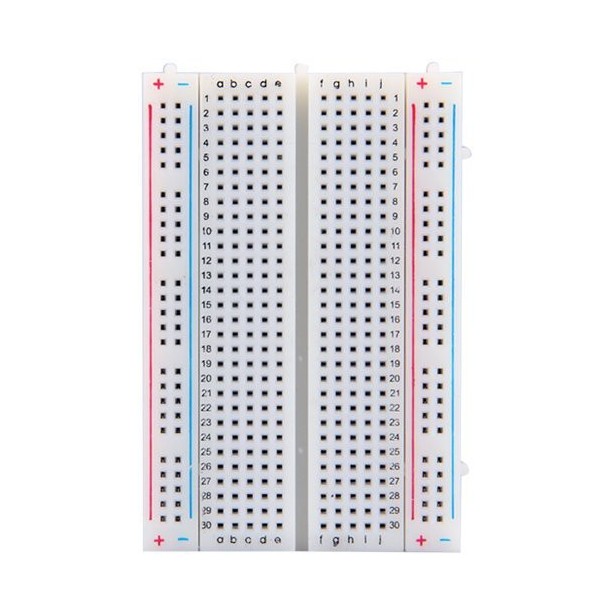
A solderless breadboard is perfect for making test circuits. No soldering is required. You simply insert the leads of electronic components through the holes. Metal clips grab on to the leads on the underside of the breadboard.
Te quedan 120€ para el envío gratis

24h Delivery

FREE for orders over 120€

Secure payment
Información del producto
This 400-point breadboard is ideal for building solderless electronic circuits. Whether you are a beginner or an advanced user, it allows you to test components, sensors and modules quickly and safely.
Perfect for use with Arduino, ESP32, Raspberry Pi, Micro:bit and many other development boards. You can mount, modify and test circuits in seconds without any tools.
Inside the breadboard there are metal spring clips arranged on a 2.54 mm grid. When you insert a component pin, the clip holds it in place and creates an electrical connection—no soldering needed.
The side power rails (red and blue/black lines) are designed to distribute power through the entire circuit:
They are coordinates to identify rows and columns. They’re not required for basic use, but they are extremely helpful in:
These are the power buses. They allow you to distribute the power supply easily:
Is it compatible with Arduino?
Yes, it is fully compatible and ideal for basic to intermediate Arduino projects.
Can I plug LEDs, resistors, sensors and modules directly?
Yes. It supports all standard 2.54 mm components and 21–26 AWG jumper wires.
Are the power rails connected all the way across?
Most 400-point breadboards come with split rails. You can link them with a jumper wire if you need a continuous rail.
Is it reusable?
Absolutely. You can insert and remove components hundreds of times without damaging it.
Is it recommended for classroom use?
Yes, it’s one of the best breadboards for STEM education and beginner electronics.
Build, test and learn real electronics without soldering!
