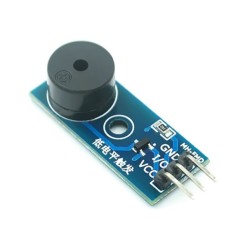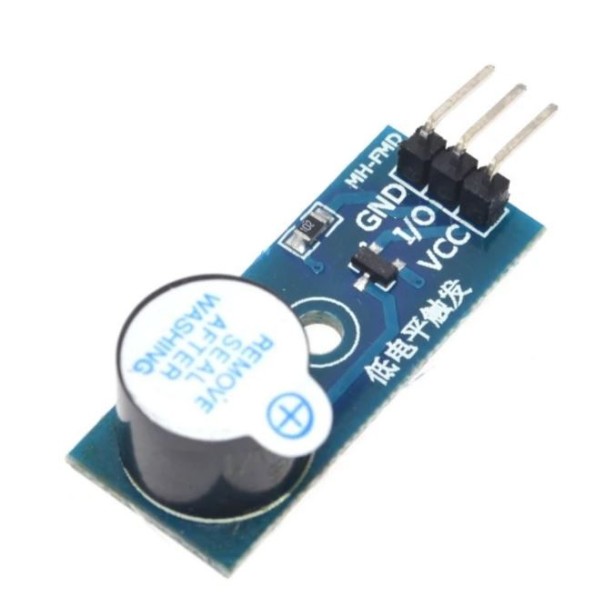
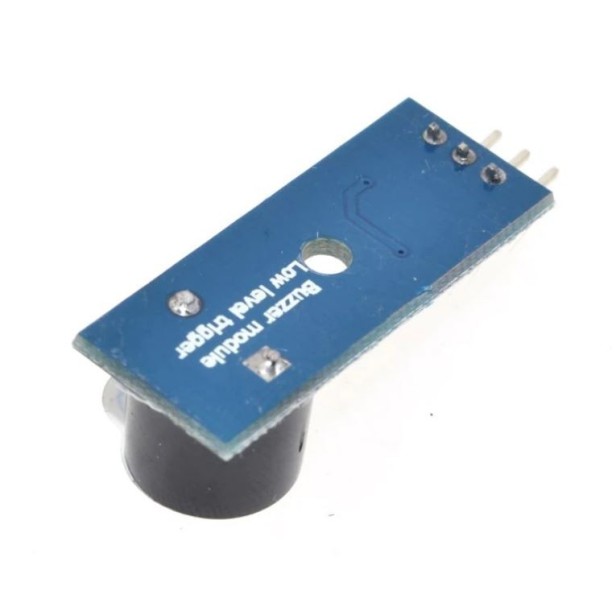
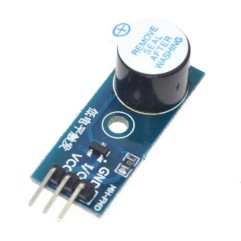
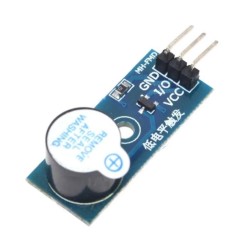
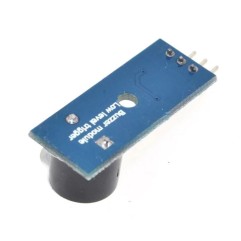
Active buzzer Module pcb
Active buzzer Module
Te quedan 120€ para el envío gratis
24h Delivery
FREE for orders over 120€
Secure payment
Usually joint purchase

Información del producto
FEATURES – ACTIVE BUZZER MODULE (PCB MOUNTED)
- Type: Active buzzer mounted on PCB.
- Operating voltage: 3.5 – 5.5 V.
- Current consumption: < 25 mA.
- Pins: 3 pins (VCC, GND, Signal).
- Buzzer dimensions: 1.9 × 1.3 × 0.1 cm (metal housing).
- Compatible with: Arduino, ESP32, ESP8266, Raspberry Pi, Micro:bit (3.3–5 V systems).
- Frequency: Fixed tone (no PWM required).
The active buzzer module is an electroacoustic transducer capable of generating a constant tone without requiring PWM from the microcontroller. It only needs power and a HIGH digital signal to start buzzing.
USES & APPLICATIONS
- Alarm and warning systems.
- Sound indicators in educational projects.
- Status indicators for robots and electronics modules.
- Timers and simple buzzers for reminders.
- DIY electronics and Arduino projects.
- Microcontrollers such as ESP32, Raspberry Pi and Micro:bit.
ADVANTAGES OF THE ACTIVE BUZZER
- ✔️ Does not require PWM — works with a simple ON/OFF signal.
- ✔️ Very easy to use for beginners.
- ✔️ Produces a clear, stable tone.
- ✔️ Ideal for fast prototyping and alerts.
- ✔️ Mounted on a durable PCB ready to plug and play.
PINOUT & CONNECTIONS
- VCC: 5 V (also works at 3.3 V).
- GND: Ground.
- S (Signal): Digital signal to activate/deactivate buzzing.
Since this is an active buzzer, it generates a fixed-frequency tone as soon as the signal pin receives a HIGH level.
HOW TO USE THIS ACTIVE BUZZER
- Connect VCC to the 5V output of your board.
- Connect GND to ground.
- Connect the signal pin to any digital I/O pin.
- Write HIGH to make it buzz, LOW to stop it.
Simple Arduino example:
digitalWrite(pin_buzzer, HIGH); // buzzer ON digitalWrite(pin_buzzer, LOW); // buzzer OFF
IMPORTANT CONSIDERATIONS
- This is an active buzzer: it plays a fixed tone, not melodies.
- For musical notes or variable tones, use a passive buzzer.
- Do not drive it directly from analog pins.
- On 3.3 V boards (Raspberry Pi), volume will be slightly lower.
- Avoid using it too close to the ear.
FAQ – FREQUENTLY ASKED QUESTIONS
Does this buzzer generate its own sound?
Yes. It only needs power and a HIGH digital signal.
Is it different from a passive buzzer?
Yes. The active buzzer has a built-in oscillator and produces a fixed tone. The passive buzzer needs a PWM signal to generate tones or melodies.
Is it compatible with Arduino?
✔️ Fully compatible and extremely easy to use.
Does it work with Raspberry Pi and ESP32?
✔️ Yes. Works at 3.3 V, though sound volume may be slightly lower.
Can I use it for alarms?
✔️ Yes. Perfect for alarms, alerts, warning tones and project indicators.
The ideal active buzzer for alarms, quick alerts and educational electronics projects.
You might also like