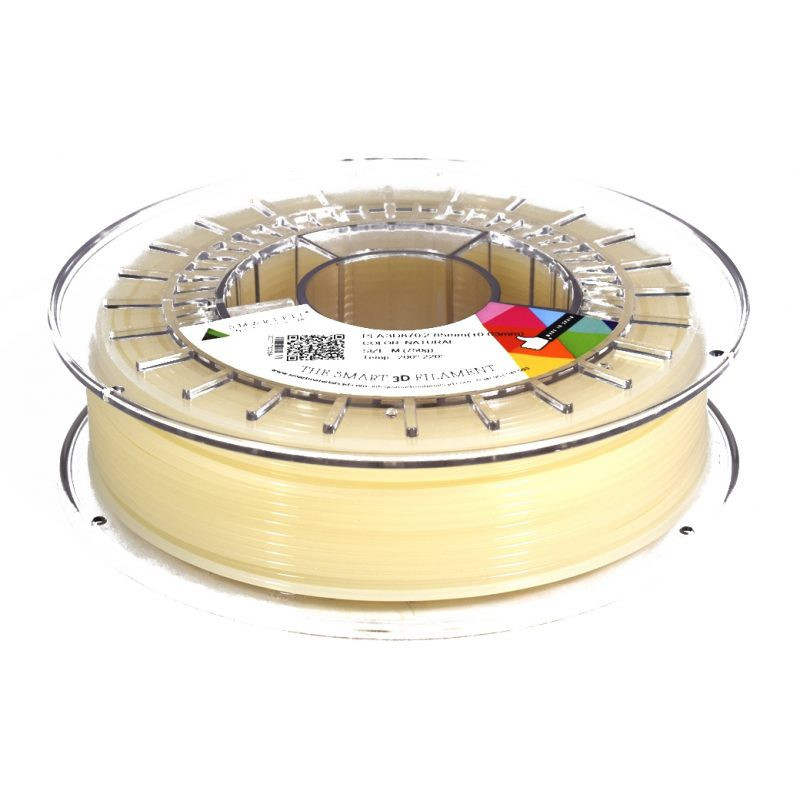
This filament offers improved thermal resistance and high strength to the impact on pieces printed with it, it has similar characteristics to the ABS keeping all the advantages of the PLA.
Te quedan
120€
para el envío gratis
24h Delivery
FREE for orders over 120€
Secure payment
Información del producto
SMARTFIL PLA 3D870 NATURAL FILAMENT FEATURES
Material type: PLA 3D870
Chemical name: Polylactic Acid
Pellet designed by: NatureWorks
Filament diameter: 1.75 mm (Ask us for 2.85 mm option)
Diameter tolerance: ±0.03 / ±0.05 mm
Color: Natural
3D printing parameters:
Nozzle temperature: 190 - 230 ºC (We recommend 230 ºC for this shade)
Other features: High mechanical and thermal resistance (similar to ABS, but easier to print)
Compatible with: Almost all 3D printers
Recyclable: Yes
Net weight: 750 g
Gross weight: 975 g
Brand: Smartfil
Manufacturer: Smart Materials 3D
Origin: Spain
MANUFACTURER RECOMMENDATIONS
Store in a dry place
Keep away from sunlight
Ideal storage temperature: 10 ºC – 40 ºC
USES AND APPLICATIONS
Prototyping
Decorative objects
Large format parts
Architectural models
What is PLA 3D870?
NatureWorks designed this PLA specifically for industrial 3D printing. It offers impact resistance superior to ABS, and once annealed, competes in thermal performance.
PLA 3D870 combines the ease of PLA printing with ABS-level mechanical performance. Compared to standard PLA, 870 offers:
Improved mechanical strength
Greater impact resistance
Better heat resistance
High printing resolution
Strong adhesion and minimal warping
Low odor
How to print PLA 3D870?
Use your slicer software with the following settings. Lower speed and layer height give finer detail, but increase print time. Dark pigments like black may require slightly higher temperatures.
Nozzle temperature: 205 – 220 ºC
Bed temperature: 40 – 60 ºC
Fan: ON (100%)
Layer height: ≥ 0.1 mm
Print speed: 30 – 60 mm/s
Material flow: 100%
POST-PROCESSING
How to anneal PLA 3D870?
Preheat oven to 110 – 120 ºC
Place the printed part inside. Use supports if needed for larger pieces
Annealing time: 20 minutes for 3.18 mm wall thickness
Cool down at room temperature without handling
Measure before and after to calculate any shrinkage
Annealing alters the molecular structure (crystallization), improving thermal and impact resistance. Be aware of dimensional changes.
MAINTENANCE
Maintain your 3D printer's extruder regularly to extend the machine’s lifespan. Use cleaning filament and brass brush as needed.